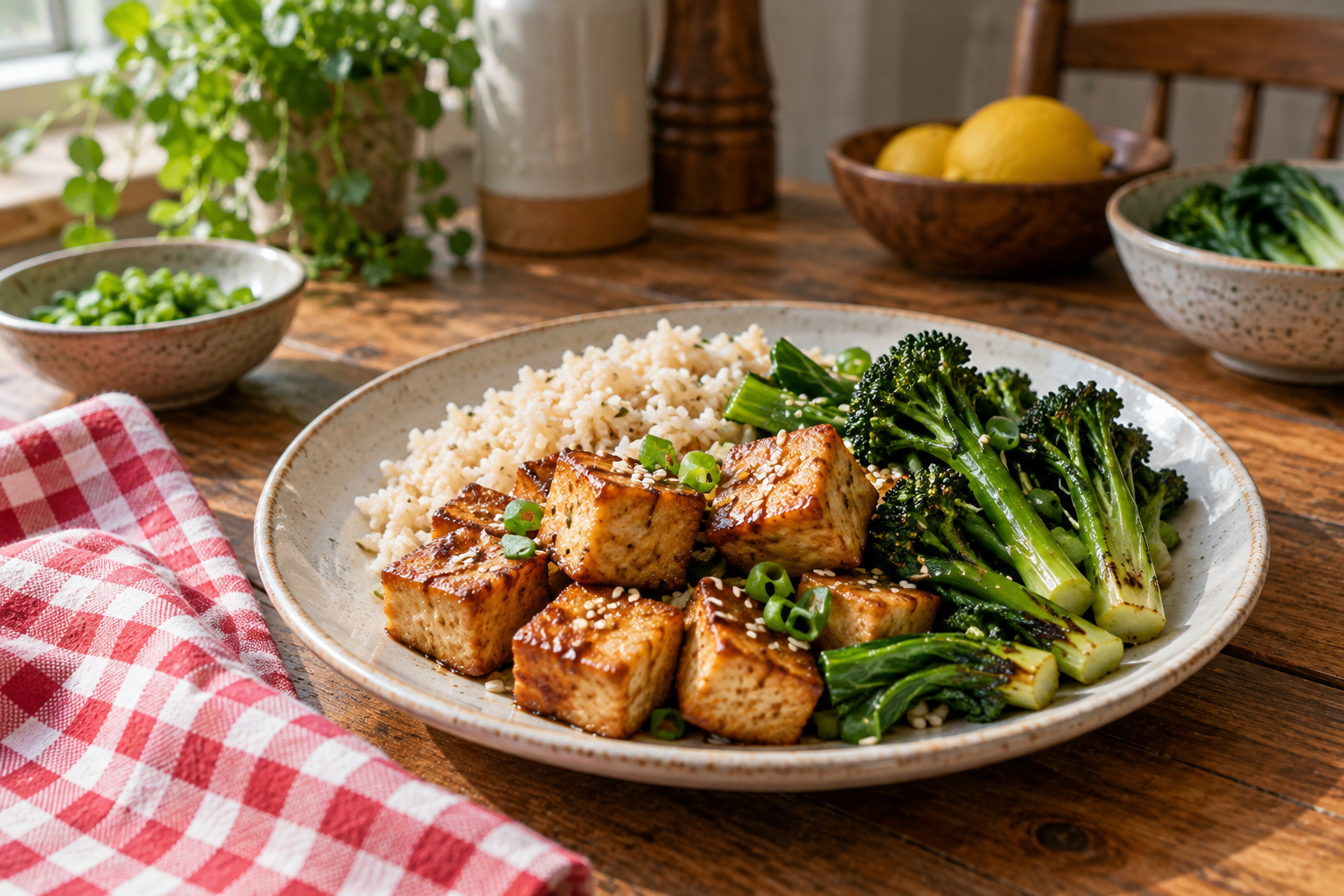
Firm tofu is usually a better starting point for cubes, slabs, and rough scrambles. Silken tofu has a more delicate structure and lends itself to smooth sauces or dishes where that softness is welcome.
Pressing silken tofu as though it were a dense block generally creates broken tofu, not a firmer ingredient. Likewise, blending firm tofu into a sauce may need more liquid and effort than using a suitable silken product.
Brands use texture words differently, so look at the package description and the recipe's needs together. Storage also varies: a shelf-stable sealed carton and a refrigerated tub may look similar after opening but need different handling beforehand. Once opened, follow the product's directions rather than assuming all tofu has the same keeping time.
Read the method before buying the block
For a pan-fried dish, look for tofu firm enough to lift and turn. For a blended sauce, consider whether a smooth silken product is specified. For a soup with delicate cubes, the recipe may deliberately want a soft texture that would be frustrating in a frying pan.
The descriptions on two brands may not line up exactly. Keep the package from an attempt you enjoyed, or note the full product name. That gives you a useful reference when the next block behaves differently.
If only another type is available, change the dish to suit it. Soft tofu can be gently warmed in broth instead of pushed through a crisp-cube method. Firm tofu can become a rough scramble rather than a silky dessert. Adapting the goal is sometimes much easier than trying to make the ingredient behave like the one you could not buy.